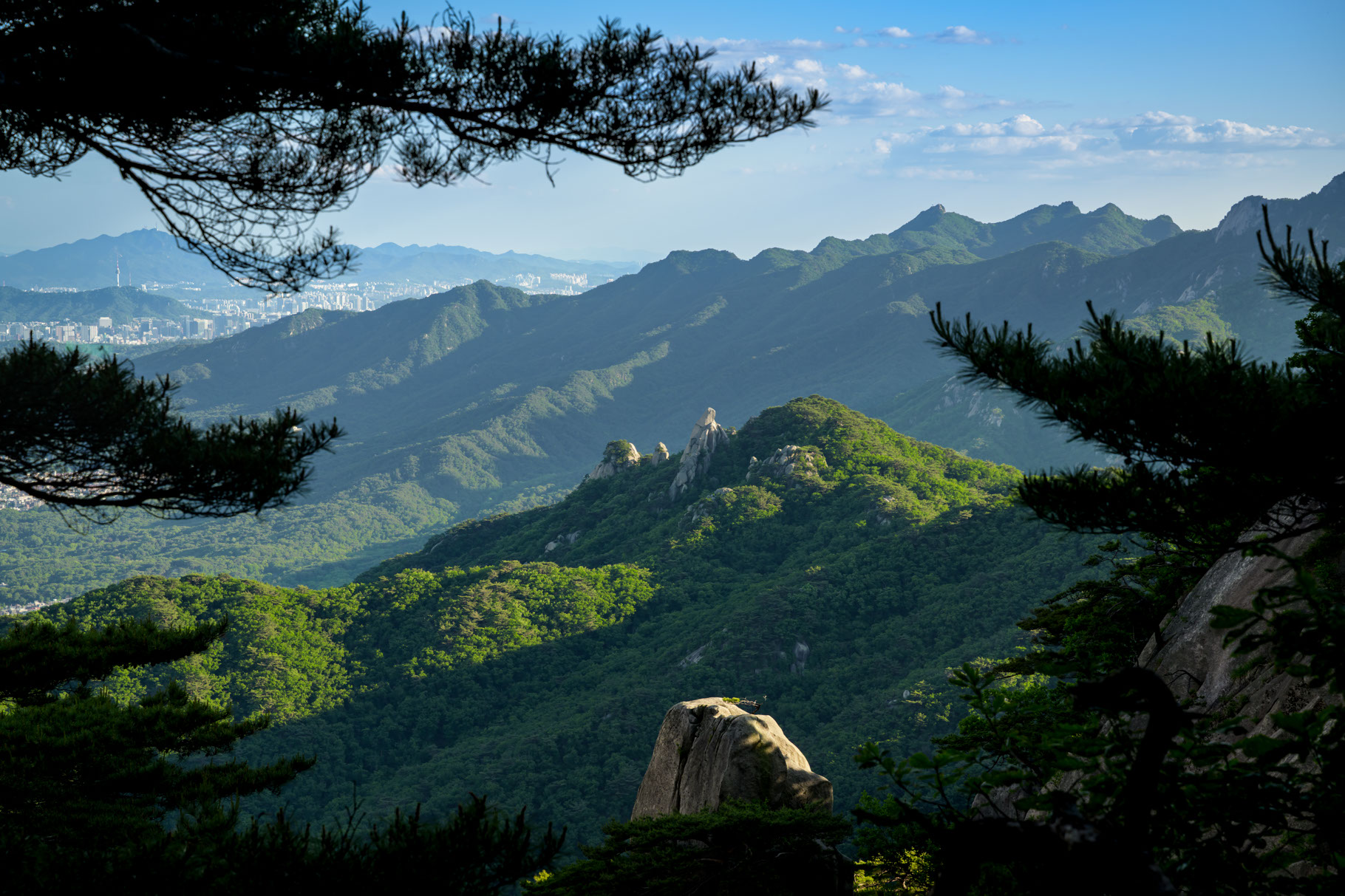
Resting at the northern reaches of Seoul, Bukhansan National Park on a clear day defines the horizon from most points in the city. The mountains of this sprawling national park are dotted with temples and shrines, a few hermitages, and countless remnants of dynasties and kingdoms past.
For much of the well-populated hiking trails a dense canopy formed by pines and oaks, in particular the Korean red pine (pdf), offers a welcome shield from summer suns even if it can’t always hold back the humidity. But reach a couple hundred meters above the city and more portals to the valleys and buildings below carve their way through the boughs and leaves and needles.
Jagged ridgelines of the nearby mountains, in some places the bare rocks emerging through the blanket of evergreen forest, fill these views. And off in the distance the city itself, its roads and towers flowing through the landscape like a river of steel and concrete. Finding every nook and corner into which new developments could extend as the volume of residents pushed over the banks of existing districts and neighborhoods during South Korea’s population boom in previous decades.
With the more stable numbers in recent decades, and a focus on balanced development and urban regeneration rather than relentless expansion, the lower courses of those rivers of humanity may be relaxing and settling toward an equilibrium with the natural terrain that encloses them in its beauty.