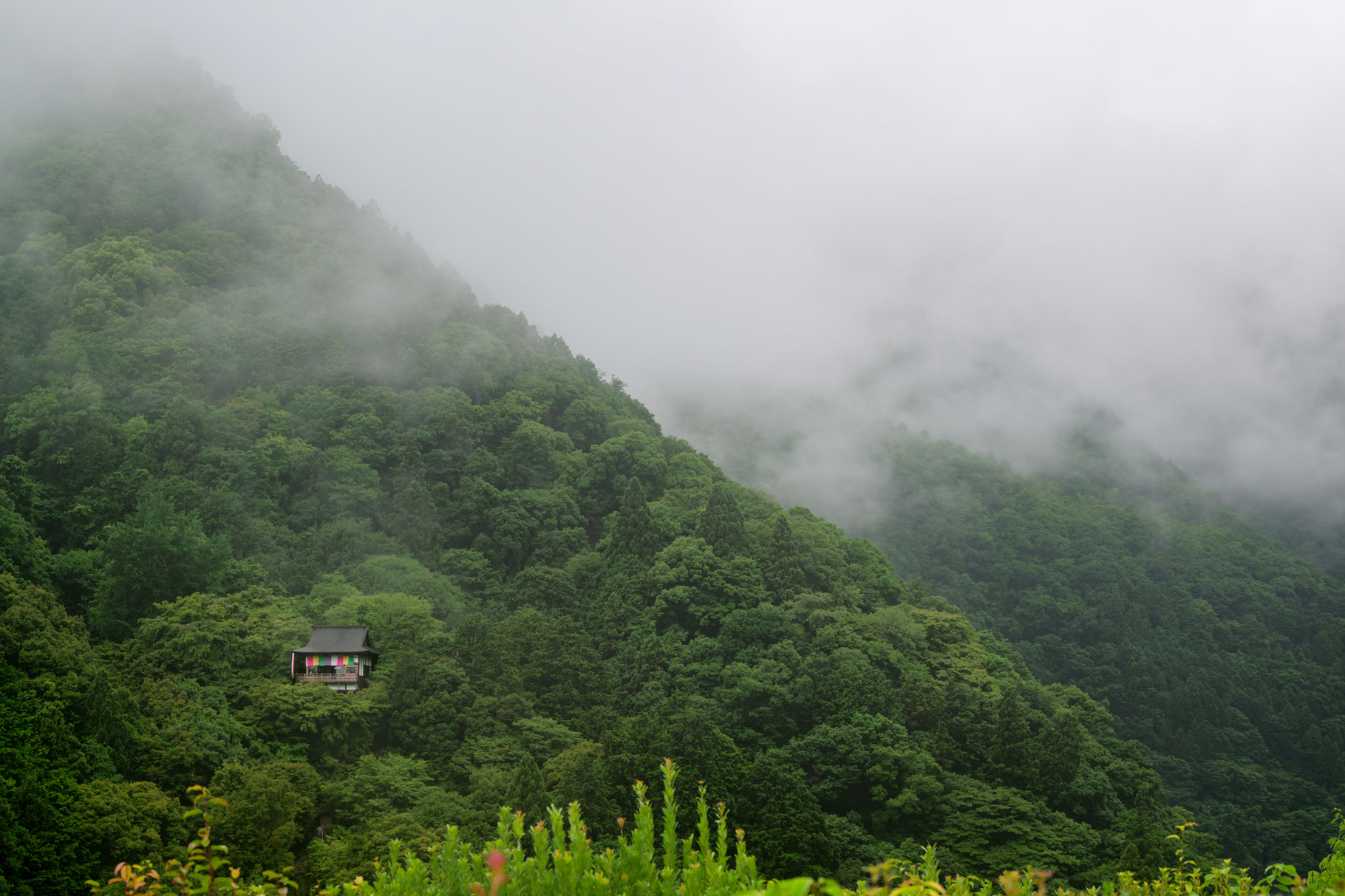
Pines and maples, so dense it would be impossible to tease them apart, hold aloft a meditation hall, its panel doors slid open to anyone capable of finding their way through the forest and up the steep path. It takes a keen eye to even see the hint between the trees of a cliffside walkway some twenty meters or so below, that winds up from the river gorge, shifting from hewn stone paths to wooden spans as the terrain demands.
Are the mists receding in a physical manifestation of a practitioner within’s attainment of the pointed clarity of enlightenment, lifting the veil of samsaric confusion and revealing the true nature of the world around? Or are they a herd charging down the mountain, threatening to envelop and trample the temple, as the distractions and obscurations which still cloud some novice’s mind?
In the mountain hermitage which is my body,
In the temple of my breast,
At the summit of the triangle of my heart,
The horse which is my mind flies like the wind.
If I try to catch him, with what lasso will I catch him?
If I try to tie him, to what stake will I tie him?
If he is hungry, what fodder will I give him?
If he is thirsty, what shall I mix with his water?
If he is cold, within what walls shall I shelter him?
If I catch him, I will catch him with the lasso of the unconditioned.
If I tie him, it will be to the stake of deep meditation.
If he is hungry, I will nourish him with the lama’s precepts.
If he is thirsty, I will water him at the perpetual stream of mindfulness.
If he is cold, I will shelter him within the walls of Emptiness.[1]
If they embody encroaching afflictions, then join in offering a small prayer of support for the seeker in the temple and their diligence and dedication in reining in the wild horse of their wandering mind.
Lhalungpa, Lobsang P., translator. The Life of Milarepa. Penguin Books, 1992. ↩︎